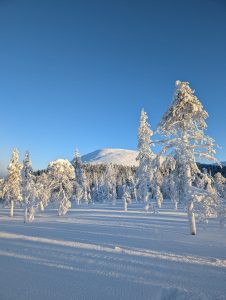
When people think of Finnish Lapland, they almost always think of winter: snow, northern lights, huskies. Fair enough, that’s what most brochures sell. But at the end of our winter safaris, one question keeps coming back: “So what’s it like here in summer?”
Here’s our answer, told as one ordinary day in June in Ylläsjärvi, where we live and welcome our guests at North Wind Lapland.
7 am: the sun has been up for ages
One of the first things that throws you in a Lapland summer is that the clock stops meaning much. In June the sun doesn’t set. It circles the horizon, dips a little, climbs again. At 7 in the morning it feels like noon. At midnight it feels exactly the same.
We start the day with coffee on the wooden terrace, looking out at the fell. Not a sound, apart from a willow warbler somewhere in the forest. The white nights do something odd to you: you sleep less, but you’re not tired. Your body just falls into step with a sun that never goes away.
10 am: by the Ylläsjoki, rod in hand
Fishing in Lapland isn’t about performance. It’s an excuse to sit by the river, listen to the water and watch what goes by. The Ylläs river runs right past our mökki, a traditional log cabin out in the middle of nature, and depending on the spot it holds char, pike and perch. We tie on a few flies, cast, and wait.
What always strikes me with visitors is the first half hour. They talk, they comment. Then the silence settles in, the real silence of the north that most of us have forgotten. That’s usually when people start to understand where they are.
1 pm: a swim in the lake
In June the lake is around 16 to 20 °C, which surprises people: Lapland isn’t cold in summer. Days can reach 30 °C, sometimes more. We swim, float on our backs and look at the sky. The lake bed is sandy in places and rocky in others. No jellyfish, no speedboats, no crowded beach. Just the water, the birches around it and the fell reflected on the surface.
After the swim we eat outside. Often grilled fish, new Finnish potatoes and a bit of rye bread. Nothing complicated.
3 pm: an encounter in the forest
In the afternoon we take the trails that climb towards Ylläs fell. That’s almost always where it happens: a movement between the pines, a pale brown shape, then another. Reindeer roam freely in Lapland. They belong to Sámi and Finnish herders, but they live semi-wild all year round. In summer you often meet them in small groups, resting in the shade or looking for lichen.
They’re not shy, but they’re not tame either. We keep our distance, watch them and let them pass. It’s a moment that doesn’t need explaining.
5 pm: foraging
By now the forest is starting to give. We cut young birch branches to make a vihta, a leafy bundle used in the sauna: in the heat, you gently whisk your skin with it to get the blood flowing and relax your muscles. We also pick young spruce shoots for syrups and teas, plus a few other plants to flavour dinner.
Blueberries come in July, then lingonberries and cloudberries (the famous lakka, a real northern treasure). You walk with a small bucket, bend down, pick. It’s slow, almost meditative work, and you eat about as many as you bring home.
For mushrooms you wait until late August: porcini, chanterelles, milk caps. Here, everyman’s right (jokamiehenoikeus) lets anyone pick freely in the forest, whether they own the land or not. It’s one of the things that surprises visitors most.
9 pm: sauna by the lake
In Finland, sauna isn’t a pastime. It’s a ritual, almost every day. In summer it becomes something else: we fire up the wood-burning sauna, sweat for twenty minutes, then walk straight out and jump in the lake. Three or four rounds. In between, we sit outside with a beer or a herbal tea and watch the sun refuse to set.
It’s probably what people remember longest after their trip. Not because it’s spectacular (it isn’t), but because of that very particular feeling of total calm.
Midnight: the sun is still there
At midnight the light turns golden, like a sunset back home, except it never goes. It just hangs there for hours. You can read outside, walk, take photos, without ever needing a torch. Words don’t really do it justice. You have to live it once to understand why so many visitors come back.
So what can you actually do here in summer?
Here’s what we offer at North Wind Lapland between June and September:
- Guided fishing on the Ylläsjoki and the lakes around it
- River paddling by canoe or kayak
- Hiking on the fells
- A day at a wilderness hut with a meal cooked over the fire
- Natural skincare workshops using local plants
- Painting workshops in the middle of the Finnish landscape
- Ice fishing as soon as the lakes freeze in autumn
Everything happens in small groups, never a tourist coach, with a guide who speaks English or French. I’m originally French and have been a certified nature guide in Finland since 2004.
And what about winter?
If you’re reading this and already planning a holiday: our winter season runs from late November to mid-April. That’s the time for snowmobile safaris, husky rides, northern lights outings, reindeer visits at a Sámi herder’s farm, and ice fishing. Many of our guests come in February or March, the best balance between daylight, reliable snow and bearable temperatures.
But coming back once in summer, after you’ve known white Lapland, is finding out you’d only seen half the picture.
Plan your trip
👉 Discover all our experiences
📍 Tirroniemenkuja 2, 95980 Ylläsjärvi, Finland
We’re a Finnish social enterprise: more than half of our profit goes back to the Ylläsjärvi village community.