Every autumn, messages arrive in our inbox at Ylläsjärvi. Someone has found the dates that suit their family, checked a lunar calendar, and written to ask whether they should move the whole trip because a full moon falls in the middle of it.
The short answer is no. Don’t move your trip.
The longer answer is more interesting, because a bright moon does not just fail to ruin an aurora night — for photography, it is often the reason a picture works at all. Here is what really happens in the sky above the collines of Ylläs when the moon is full.
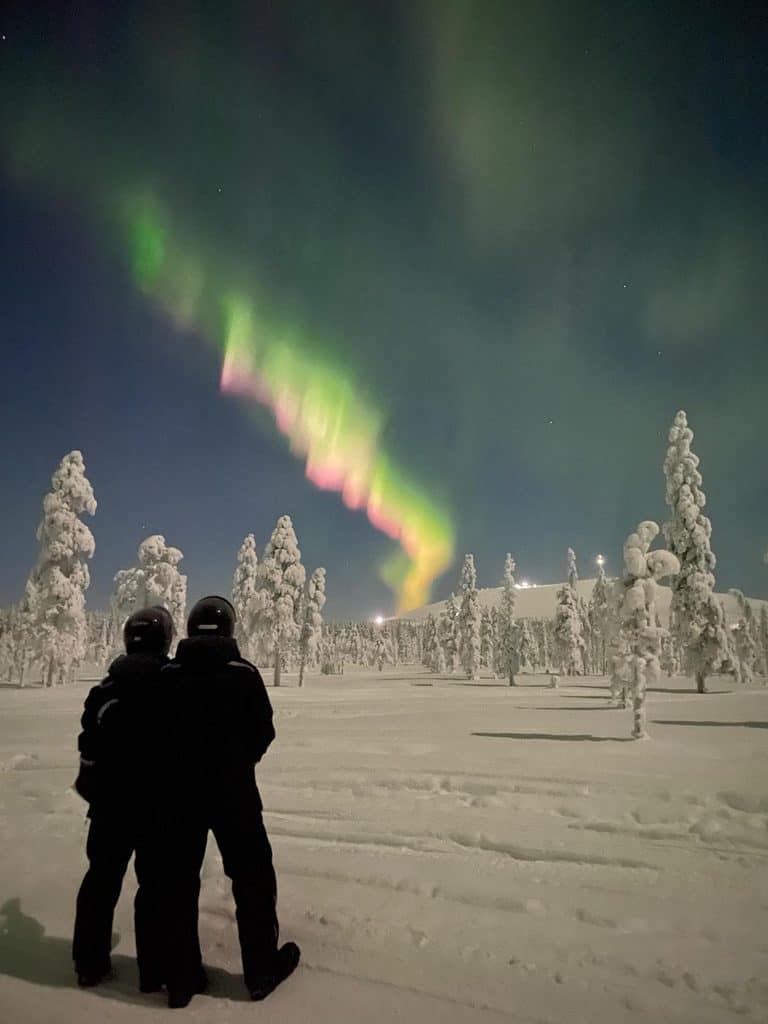
Where the myth comes from
The reasoning sounds sensible. Moonlight brightens the sky. A brighter sky means less contrast. Less contrast means a fainter aurora. Therefore: avoid the full moon.
Each step is true in isolation. The conclusion is still wrong, because the effect is far smaller than people imagine, and because it only bites in one narrow case.
The full moon is roughly 400,000 times fainter than the sun. It is bright enough to read a headline by, once your eyes have adjusted, and bright enough to cast a shadow on snow. It is nowhere near bright enough to erase a real aurora. Aurora scientists grade displays on a brightness scale where a mid-range display is comparable to moonlit cloud, and a strong one is brighter than the full moon itself. A curtain that is actually doing something will not be washed out. It will simply be seen against a deep blue sky instead of a black one.
What moonlight genuinely costs you
Honesty matters more than a good story, so here is the real trade-off.
Moonlight will flatten the very faintest displays — the dim grey-green arc sitting low on the northern horizon that you have to look slightly away from to notice at all. On a moonless night that arc is a quiet, private thrill. Under a full moon, you may not register it.
That is the entire cost. One category of display, the weakest one, that your camera will catch but not your eyes, becomes harder to catch. Everything from a decent arc upwards is unaffected, and if the display develops — the moment the arc brightens, folds and starts to move — the moon becomes irrelevant.
The thing nobody mentions: where the moon actually sits
Here is the detail that changes how you think about this.
In deep winter, at our latitude, the full moon behaves the way the summer sun does. It rides high and it crosses the southern sky. The aurora, meanwhile, usually forms an arc across the north.
So on a full-moon night in January, you are typically standing with the moon behind you, lighting the landscape in front of you, while the aurora does its work in the opposite direction. It is not competing with your view. It is lighting your stage.
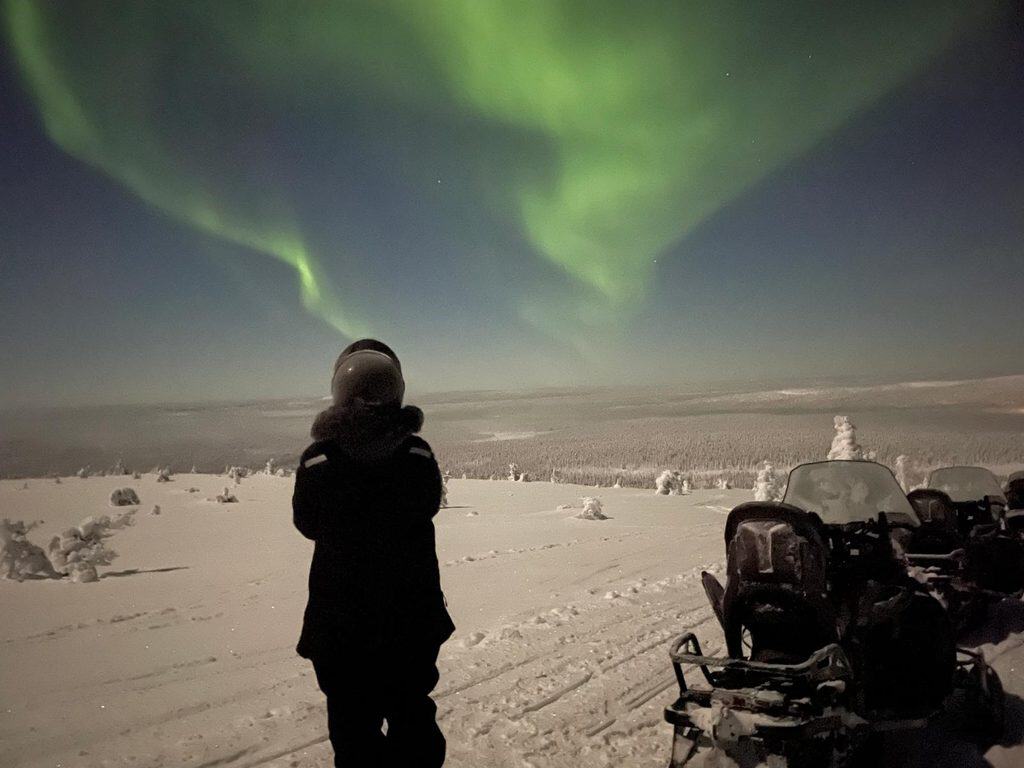
Why photographers ask for the moon
Ask anyone who photographs the aurora seriously and you will hear the same thing: a moonless night gives you green light above a black nothing.
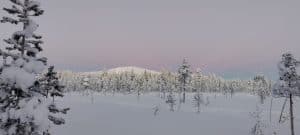
Moonlight solves that. On a full-moon night in Lapland the snow acts as an enormous reflector, and suddenly your photograph has a foreground — snow-laden spruce, the curve of a frozen lake, the shape of the colline behind. The sky turns a deep blue rather than dead black. The image has depth instead of a single bright stripe.
It helps technically, too. With a lit landscape you can shoot at a lower ISO and a shorter exposure. That matters more than most people realise, because an active aurora moves fast. A fifteen-second exposure smears the curtains into a soft green wash; a four-second exposure keeps the vertical rays and the sharp lower edge that make the display look the way it looked to your eyes. Moonlight buys you those shorter exposures.
If you are shooting on a phone, the difference is even larger. Phone night modes struggle when there is nothing to focus on and nothing to meter from. A moonlit landscape gives the camera both.
Tips on how to take pictures of northern lights with a smartphone: https://northwindlapland.com/how-to-take-pictures-of-northern-lights/
What actually ruins an aurora night
If you want to worry about something, worry about these, in order.
Cloud. This is the only real enemy. A solid overcast ends the discussion, whatever the sun and the moon are doing. Under a full moon you can at least see where the gaps are — which is why we often move under a bright moon and stay put under a dark, cloudy one.
Solar activity. No particles, no aurora. The current solar cycle is past its peak, but the declining phase is not the disappointment it sounds like: recurring coronal holes send high-speed solar wind past Earth on a repeating cycle, and the strongest storms of a cycle often arrive in the years after the maximum rather than at it.
Light pollution. A town’s lights sit low and stay on all night. The moon at least moves, sets, and changes phase. This is why we drive away from the resort lights and out towards the dark, quiet places around Ylläsjärvi — and it is why our village position matters more than the lunar calendar.
Going to bed too early. More displays are missed to tiredness than to moonlight.
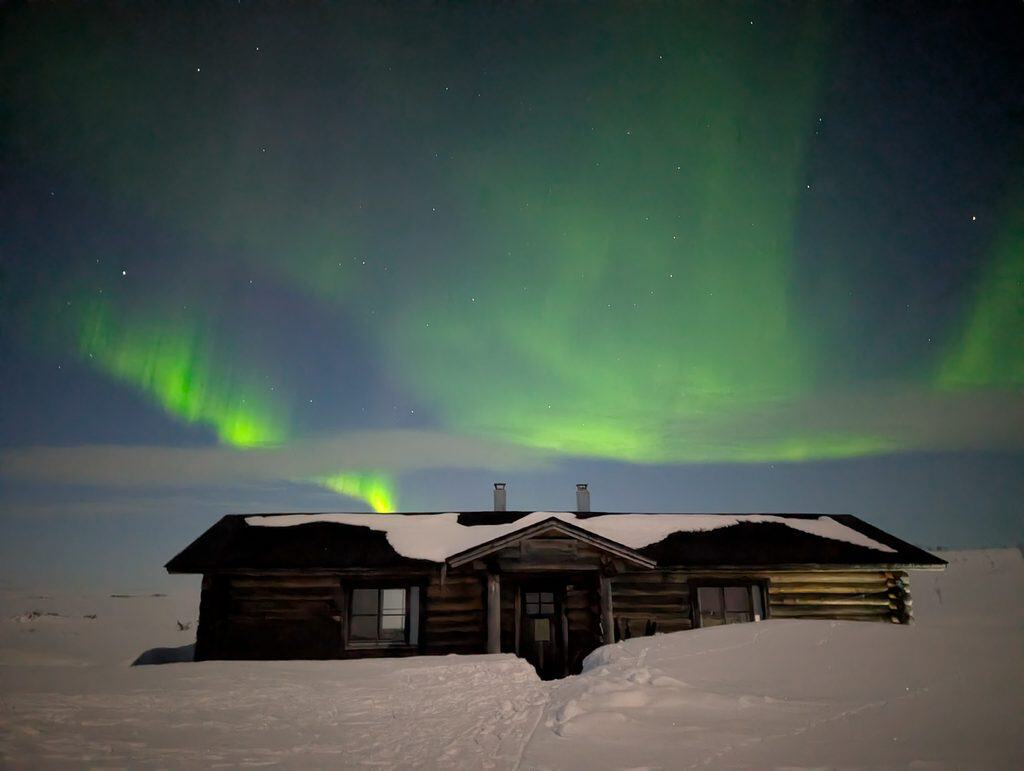
Full moon nights in Ylläs this winter
If you would like to plan for a moonlit aurora rather than against one, these are the full moons of the coming season, in Finnish time:
- 24 November 2026
- 24 December 2026 — the moon turns full in the early hours of Christmas Eve
- 22 January 2027
- around 20–21 February 2027
- 22 March 2027
Snow cover is usually deep and reliable from around the turn of the year, so the January and February moons tend to give the most spectacular moonlit landscapes. The December full moon falling on Christmas Eve is, we think, a rather good excuse.
How we work with it
When we take a group out under a full moon, we plan the evening differently rather than apologising for the conditions. We choose spots where the moon is at our backs and the northern horizon is open. We use the lit landscape for composition instead of fighting it. And we spend the waiting time somewhere the view is worth having even before the aurora arrives — which, under a full moon on snow, it very much is.
You do not need to rearrange your holiday around a lunar calendar. You need a clear sky, a dark direction to look in, someone who knows where to go, and the patience to stay out.
Check our Northern Light tours here: https://northwindlapland.com/northern-lights-experiences/