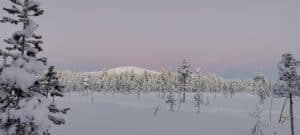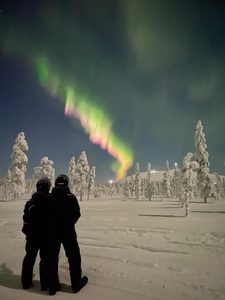
It is well after dark. The snow under your snowshoes has gone quiet, the forest behind you is a black wall of spruce, and the only light comes from the stars and the snow itself. Low in the north there is a pale grey smudge that looks like a cloud that will not move. Most people would walk straight past it. We ask you to stop, and wait.
Twenty minutes later, that smudge can be a green band right over your head. Or it can stay a smudge all night. No app on your phone could have told you which, and that is really what this post is about.
Most people arrive in Ylläs with an aurora app already open, and by the second evening they have stopped enjoying it: the numbers keep moving and nobody has said which ones matter. We read the same public data you do. Here is how we make sense of it, in plain words.
That KP number on your app
The number everyone watches is KP. It is a rough, global score from 0 to 9 for how unsettled the Earth’s magnetic field is, worked out over three hours from observatories well to the south of us. It is useful to scientists. It is not a forecast for the sky above Ylläsjärvi.
Two things follow from that. A burst of aurora can rise and fade in twenty minutes, far quicker than a three-hour figure can show. And because the number is averaged across the planet, it says nothing about the clouds, the darkness or the trees around you tonight.
Why a low number is fine up here
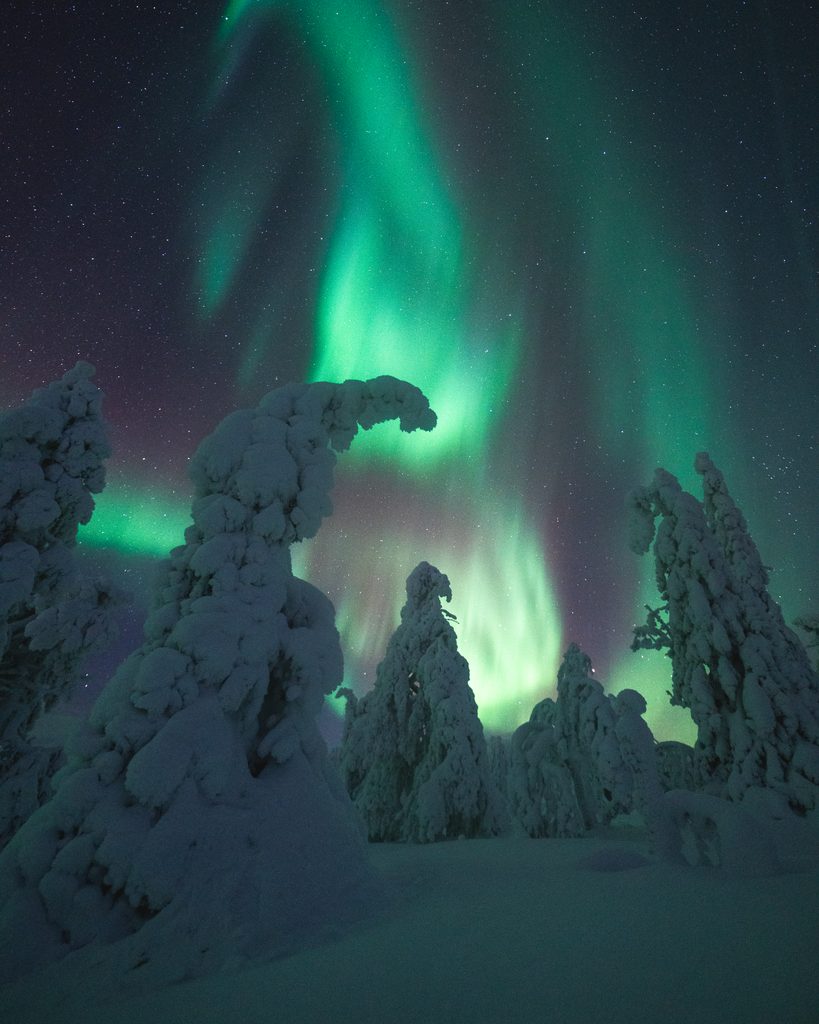
The aurora sits in a ring around the magnetic pole. According to the Finnish Meteorological Institute, Finland lies on the southern edge of that ring. On an ordinary quiet night it is already over our heads. We do not need a storm to bring it to us.
When KP climbs, the ring brightens and slips further south. That is good news in Yorkshire or Brittany. For us it can mean the brightest band slides south of the village, and we watch it on the southern horizon rather than overhead. In our own experience, we have had excellent nights at KP 1 and flat, shapeless ones at KP 5.
So treat KP 0 to 2 as normal here, not hopeless, and do not treat KP 5 as a ticket. If you are choosing January dates by hunting for a big KP number in a long-range forecast, you are hoping for the wrong thing.
Cloud usually decides the night
In our own planning, the deciding question is rarely the sun. It is whether there is a gap in the cloud, and where. The aurora happens around 100 kilometres up. Cloud at 2 kilometres wins every time.
- Not all cloud is equal. Thin, high cloud dims the aurora, but you can see through it. A low grey blanket ends the night.
- The fell makes its own weather. Ylläs rises to just over 700 metres and catches cloud the flat ground below does not, so the village and the fell top can disagree completely.
- Cloud moves. If the forecast says it clears from 23:00, take it seriously. Going to bed at 21:30 because it is overcast is how most visitors miss their aurora.
For cloud we rely on the Finnish Meteorological Institute, because it knows Lapland better than the global models do.
If you enjoy data, the live solar wind readings are the one set of numbers that gives genuine short notice, typically 15 to 60 minutes. We gather them, along with KP and cloud, on our northern lights alert page for Ylläs: the same public data, put together for one place instead of a whole hemisphere.
Be wary of any app that gives a single “chance of aurora” percentage for a whole night, or promises a reliable aurora forecast for one village three days ahead. Nobody can honestly do that.

What really makes the difference
Honestly: how long you stay outside, and how far you are from a street lamp. Those beat every number above.
The pale arc we described at the start is the aurora most people miss. Standing still in the cold for an hour with nothing happening is the real skill, and no forecast prepares you for it. Where you stand matters too. We have written separately about where to position yourself around Ylläs, and about why a full moon is not the problem you have been told it is.
Come and read the sky with us
We run Chasse aux Aurores Boréales en Raquettes on foot because snowshoes let us leave the road. We cross frozen marshland and taiga forest to open clearings with a real horizon, which is exactly what a faint, low arc needs.
The walk lasts about two and a half hours, after dark, with a maximum of eight people and a minimum age of six. Transfers, winter clothing and snowshoes are included, and there is a campfire with a hot drink and a marshmallow to grill. Your guide will tell you what the data said at 17:00, what the sky is doing now, and why the two differ.
We will not promise you an aurora, and nobody honest will. We will get you onto dark ground, keep you warm enough to stay out, and make sure that if it happens you are looking the right way. If you would rather watch the numbers from a warm room and step out when they peak, that is a sensible holiday too, and you do not need us for it.
If you are picking dates now, book several nights rather than one, and take the walk early in your stay so there is room to try again.